
Saturday 25 July – Tour de France stage 20: Le Bourg d'Oisans → Alpe d'Huez (170.9 km)
Route
Stage 20 is the hardest mountain stage of the Tour de France 2026 and the second consecutive stage finishing on Alpe d'Huez. From Le Bourg d'Oisans, riders cover 170.9 kilometres with 5,450 metres of climbing across four categorised ascents, three of which are hors catégorie.
Immediately after the start, the road climbs via the Col de la Croix de Fer (24.0 km at 5.2%), summit at km 33.7 at 2,067 metres. The climb features varying gradients with short descents. After the summit, the road drops to Saint-Jean-de-Maurienne, followed by the Col du Télégraphe (11.9 km at 7.1%), summit at km 87.6 at 1,566 metres. Almost immediately after, the Col du Galibier begins (17.7 km at 6.9%), the highest point of this Tour at 2,642 metres, reached at km 110.5.
After the descent via the Col du Lautaret towards the Romanche valley, riders reach the Col de Sarenne at Mizoën (12.8 km at 7.3%), summit at km 156.5 at 1,999 metres. The Sarenne regularly features gradients above 10%. After the summit, the road descends towards Alpe d'Huez. On the D211, the final 3.7 kilometres average 6.2% to the finish at 1,850 metres.
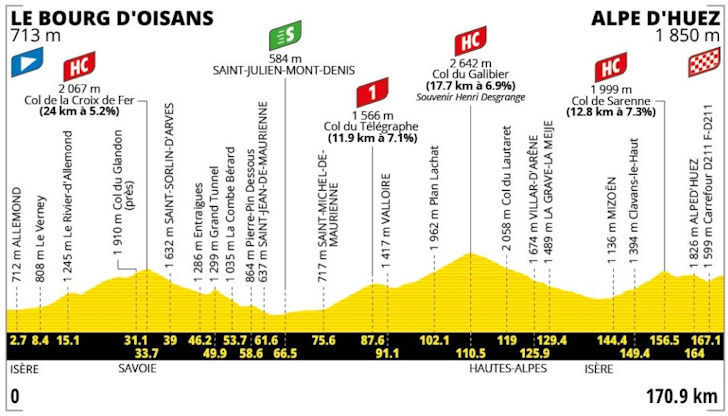
Tour de France 2026 etappe 20 – hoogteprofiel
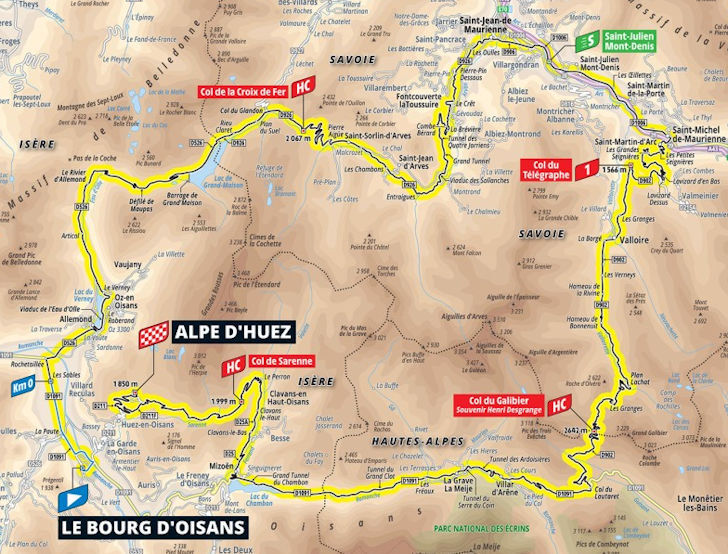
Tour de France 2026 etappe 20 – routekaart
Final kilometres
After the summit of the Col de Sarenne (km 156.5), a descent of more than 13 kilometres follows. At km 167.1, riders join the D211, the road through Alpe d'Huez. The final 3.7 kilometres climb at an average of 6.2%, with the steepest sections at the start. Finish at 1,850 metres altitude.
Recent editions
Previous finishes on Alpe d'Huez in the Tour de France (for men):
2026 (stage 19) - Tadej Pogacar crushed the Pantani KOM-record and set it to 35 minutes and 27 seconds.
2022 – Tom Pidcock (INEOS Grenadiers), solo from the descent of the Croix de Fer.
2018 – Geraint Thomas (Team Sky), stage win and yellow jersey in the same stage.
2015 – Thibaut Pinot (FDJ), attack on the final climb.
2013 – Christophe Riblon (AG2R La Mondiale), the only previous Tour stage via the Col de Sarenne, solo with a minute's lead over Tejay van Garderen.
The Col de Sarenne had only appeared in the Tour once before (2013). Back then, the climb was tackled from the Alpe d'Huez side; in stage 20 of 2026, the other, harder side takes its turn.
Scenarios
With 5,450 metres of climbing and three hors-catégorie climbs, this is terrain for climbers who still have something in their legs in the finale. The Sarenne demands explicit attacks: the climb is 12.8 kilometres with sections above 10%, and the descent afterwards partly determines who enters Alpe d'Huez first. The final kilometres (3.7 km at 6.2%) are too short for a big solo from far out, but steep enough to decide gaps in the finale.
This is the second consecutive stage to Alpe d'Huez. How stage 19 has affected the standings will play a role in the tactical choices on the Sarenne for the podium fight.
Local
Le Bourg d'Oisans lies in the Romanche valley in the Isère department, at the foot of Alpe d'Huez and the Col de la Croix de Fer. The village is a classic starting point for climbing routes in the Oisans. Alpe d'Huez first appeared in the Tour in 1952, with a victory by Fausto Coppi. The most recent Tour finish on Alpe d'Huez was in 2022, won by Tom Pidcock (INEOS Grenadiers). In 2026, the Tour finishes twice on Alpe d'Huez: stage 19 (Gap, via the classic route with the 21 hairpin bends) and stage 20 (Le Bourg d'Oisans, via the Col de Sarenne).
Tour de France 2026 stage 20: favourites
The prediction of the 💻, Expected Win (xW):
|
Name
|
Team
|
Win %
|
|---|
🦄 Yannis Voisard
*The unicorn is our joker, nice old-fashioned based on feeling