
Saturday 18 July – Tour de France stage 14: Mulhouse → Le Markstein (155.3 km)
Route
The fourteenth stage of the Tour de France 2026 goes from Mulhouse to Le Markstein over 155.3 kilometres. The route makes a loop through the Vosges with seven categorised climbs and 3,800 metres of elevation gain.
The stage opens with the Grand Ballon (21.6 km at 4.7%), the highest peak in the Vosges at 1,336 metres. The climb begins at km 14.4 in Uffholtz. After the summit at km 36.6, the route descends to Le Markstein, where the peloton passes the finish line for the first time at km 43.9. Then begins a loop of over 110 kilometres via Kruth.
After the descent comes the Col du Page (9.8 km at 4.7%) at km 71.3. Almost immediately after comes the Ballon d'Alsace (8.9 km at 6.9%) at km 94.4; at the summit there are still 61 kilometres to go. The route then includes the Col du Schirm (3.7 km at 5.3%) and the Col du Hundsruck (3.6 km at 5.2%). The decisive climb is the Col du Haag (11.2 km at 7.3%), which begins at km 142.3 in Geishouse. The first 4 kilometres rise at 9%. After a shorter, flatter section, the final kilometre before the summit ramps up to 9.5%.
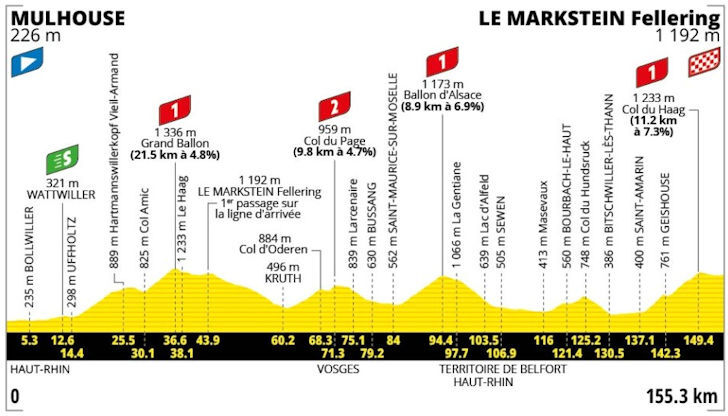
Tour de France 2026 etappe 14 – hoogteprofiel
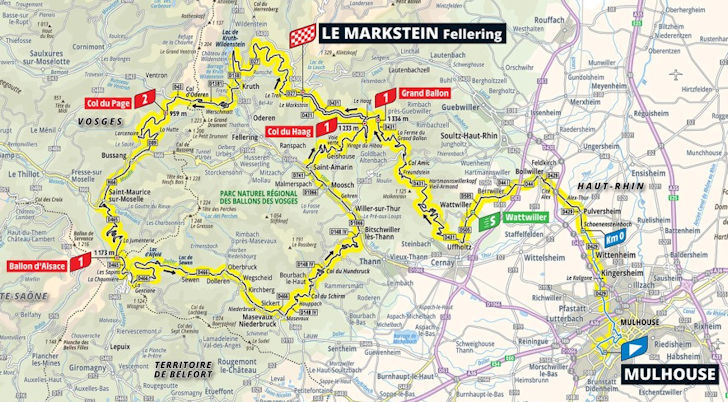
Tour de France 2026 etappe 14 – routekaart
Final kilometres
The Col du Haag reaches its summit at km 149.4. After that, 5.9 kilometres of rolling terrain lead to the finish in Le Markstein at 1,186 metres altitude. The average gradient of the very last kilometre of the stage is 2.1%. The finish is not on a mountain top, but after a descent and a short undulating section. Riders who crest the Col du Haag first could hold a small margin for this final stretch.
Recent editions
Le Markstein last served as a stage finish in the Tour de France in 2023. Stage 20 (Belfort – Le Markstein, 133.5 km) was won by Tadej Pogacar (UAE Team Emirates) in a sprint from a select group, ahead of Felix Gall (AG2R Citroën) and Jonas Vingegaard (Jumbo-Visma). Vingegaard confirmed his overall victory in that stage.
Scenarios
With some difference in the general classification, a stage with 3,800 metres of elevation and seven categorised climbs offers room for time gaps. The loop structure calls for a tactical plan: the Grand Ballon opens early and demands energy; the Ballon d'Alsace follows at km 94.4, more than 60 kilometres from the finish. Both climbs are traps for teams that accelerate too early.
The Col du Haag is the decisive point. Two scenarios are realistic: an early breakaway that maintains sufficient advantage on the Col du Haag over a reducing peloton; or a selection of GC riders on the Ballon d'Alsace that decides the race early. At the finish in Le Markstein, 5.9 kilometres after the summit of the Col du Haag, climbers with a finishing kick have the advantage.
Local
Mulhouse is an industrial city in Alsace, known for the Cité de l'Automobile, the largest car museum in Europe. Axel Zingle was born in Mulhouse. Le Markstein is a ski resort at 1,186 metres altitude in the Vosges, on the border of the Haut-Rhin and Vosges departments. The Tour de France finished there for the first time in 2023.
Tour de France 2026 stage 14: favourites
The prediction of the 💻, Expected Win (xW):
|
Name
|
Team
|
Win %
|
|---|
🦄 Pablo Castrillo
*The unicorn is our joker, nice old-fashioned based on feeling