
Friday 17 July – Tour de France stage 13: Dole → Belfort (205.8 km)
Route
Stage 13 of the Tour de France 2026 is the longest stage of this year: 205.8 kilometres from Dole to Belfort with 2,400 metres of climbing. The character is hilly, with two categorised climbs in the finale and a long descent to the finish in Belfort.
The first 150 kilometres pass over rolling terrain through the departments of Jura, Haute-Saône and Doubs, without any categorised climbs. In Mélisey, at km 137.8, the intermediate sprint takes place. At km 157.4 begins the Col des Croix (5.2 km at 4.8%, Cat 3), followed by a descent to the valley of the Moselle. Then comes the main climb: the Ballon d’Alsace starts at km 167.1 and reaches the summit at km 175.9. It is a climb of 8.8 km at 6.9% with gradients up to 8.8%, first category, at 1,173 metres altitude. The Ballon d’Alsace was in 1905 the first categorised climb in the history of the Tour de France.
After the summit of the Ballon d’Alsace, the riders descend on a technical route, after which the road gradually drops towards Belfort, still 30 kilometres away. Within the final 5 kilometres there is a stretch of 800 metres at 8%. After that the road descends to the finish line in the city centre of Belfort. The average gradient of the final kilometre is 0.9%.
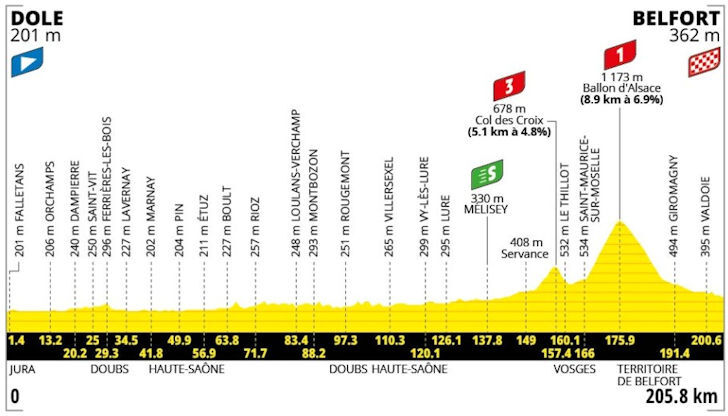
Tour de France 2026 etappe 13 – hoogteprofiel
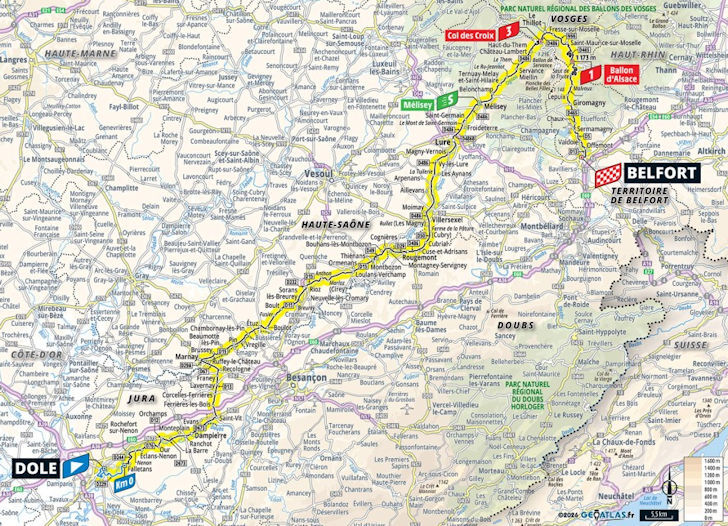
Tour de France 2026 etappe 13 – routekaart
Final kilometres
The summit of the Ballon d’Alsace lies 30 kilometres from the finish in Belfort. The first half of those 30 km is a technical descent; after that the road gradually drops towards the city. At around 5 kilometres from the finish there is a stretch of 800 metres at 8%. Those who can still accelerate here have a clear advantage. After that the road descends to the line. The average gradient of the final kilometre is 0.9%.
Recent editions
Belfort receives its first stage finish in the Tour de France since 1978. That year the Belgian Marc Demeyer won in a sprint ahead of the Dutchman Jan Raas. The Ballon d’Alsace previously served as a summit finish: 1979 – Pierre-Raymond Villemiane (Fra), 1972 – Bernard Thévenet (Fra), 1969 – Eddy Merckx (Bel), 1967 – Lucien Aimar (Fra). In 2026 the stage does not finish at the summit but 30 km lower in Belfort.
Scenarios
Climbers outside the GC battle have the best chances in this stage. The Ballon d’Alsace is hard enough to split a breakaway, but the 30 kilometres after the summit give the GC leaders’ teams room to control if they wish. Those who crest the summit with a sizable lead can hold on in Belfort.
The ideal breakaway rider combines climbing ability with a good descent and a finishing sprint after the 650-metre stretch at 5% in the finale. The GC teams will likely not waste energy here, with the heavier stages 14 and 15 on the horizon. This is a day for climbers who are far down in the standings and have nothing to lose: they can ride away early and use the Ballon as a selection tool. Riders such as Ben Healy (EF Education-EasyPost) and Richard Carapaz (EF Education-EasyPost), known for aggressive racing and attacking from far out, fit this profile.
Local
Dole, the start town, is the birthplace of Louis Pasteur (1822). The stage passes through Mélisey at km 137.8, the hometown of former rider Thibaut Pinot, who ended his professional career after the Tour de France of 2023. His father Régis Pinot has been mayor of Mélisey since 2008. Belfort is a fortress town, nationally known for the Lion de Belfort, the statue created by sculptor Frédéric Bartholdi to commemorate the defence of the city during the Franco-Prussian War of 1870-1871. The city hosts the annual Eurockéennes, one of the largest music festivals in France.
Tour de France 2026 stage 13: favourites
The prediction of the 💻, Expected Win (xW):
|
Name
|
Team
|
Win %
|
|---|
🦄 Maxim Van Gils
*The unicorn is our joker, nice old-fashioned based on feeling