
Sunday 16 August 2026: ADAC Cyclassics Hamburg – Buxtehude – Hamburg (205.3 km)
The 29th edition of ADAC Cyclassics Hamburg covers 205.3 kilometres and includes around 1,800 metres of climbing, spread over five identical ascents of the same hill. The route combines a long, flat opening section through northern Germany with a closed finale around Hamburg, where the race is decided. For the second year in a row, the start is in Buxtehude, while the finish, just as in 2025, is on the Mönckebergstraße in the centre of Hamburg.
After the neutralised start near Buxtehude, the race is released on the L127, heading towards Apensen and Beckdorf. Via Moisburg, Hollenstedt and the municipality of Rosengarten with Sottorf and Vahrendorf, where the intermediate sprint is also located, the peloton moves towards Hamburg. After 38.1 kilometres, the Hamburg city area is reached, and after 45.4 kilometres the harbour follows. At kilometre 55.2 the peloton crosses the Köhlbrandbrücke, one of the most striking passages of the day, after which the route leads via HafenCity to the city centre. Via the Jungfernstieg, the Platz der Republik and the Elbchaussee, the peloton reaches the western districts of Hamburg, where the course gradually becomes hillier.
Around kilometre 80, the hills of the Elbe suburbs follow: first the Kösterberg, and after a steep descent along the Elbe, the climb to the Waseberg in Blankenese. This roughly 700-metre climb, with gradients of up to 16 percent, is the key to the race and is climbed five times in total, at 89.6, 128.5, 139.6, 178.6 and 189.8 kilometres. Between the first passage of the Mönckebergstraße (105.1 km) and the second (155.1 km) lies a more compact series of loops, with the second and third climbs of the Waseberg only 11.1 kilometres apart. After the final Waseberg passage, with 15.5 kilometres remaining, a flat run-in follows back to the Mönckebergstraße, where the race is decided.
Since the late 2000s, ADAC Cyclassics has mainly been known as a sprinters' race, although the honour roll shows that the Waseberg regularly throws a spanner in the works. Erik Zabel built an unmatched record of six wins between 1997 and 2004, while the race has been more unpredictable in recent years. Last year, Rory Townsend, after a long breakaway, held off the peloton by the narrowest of margins at the line, after Marco Haller in 2022 and Mads Pedersen in 2023 won from a breakaway group and a reduced group respectively.
Previous winners
The race was not held in 2020 and 2021 due to the coronavirus pandemic. Overview of the winners of the last ten editions:
- 2025: Rory Townsend
- 2024: Olav Kooij
- 2023: Mads Pedersen
- 2022: Marco Haller
- 2019: Elia Viviani
- 2018: Elia Viviani
- 2017: Elia Viviani
- 2016: Caleb Ewan
- 2015: André Greipel
- 2014: Alexander Kristoff
With Jonathan Milan and Paul Magnier, two fast men who rank among the quickest in the peloton on pure power alone will be at the start, although it remains to be seen how much the five climbs will take out of them. A puncheur like Arnaud De Lie could benefit from this if the final Waseberg passage makes the difference. Just as in 2025, it will depend on the strength of the sprinters' teams whether the race still ends in a bunch sprint, or whether a smaller group is the first to reach the Mönckebergstraße.
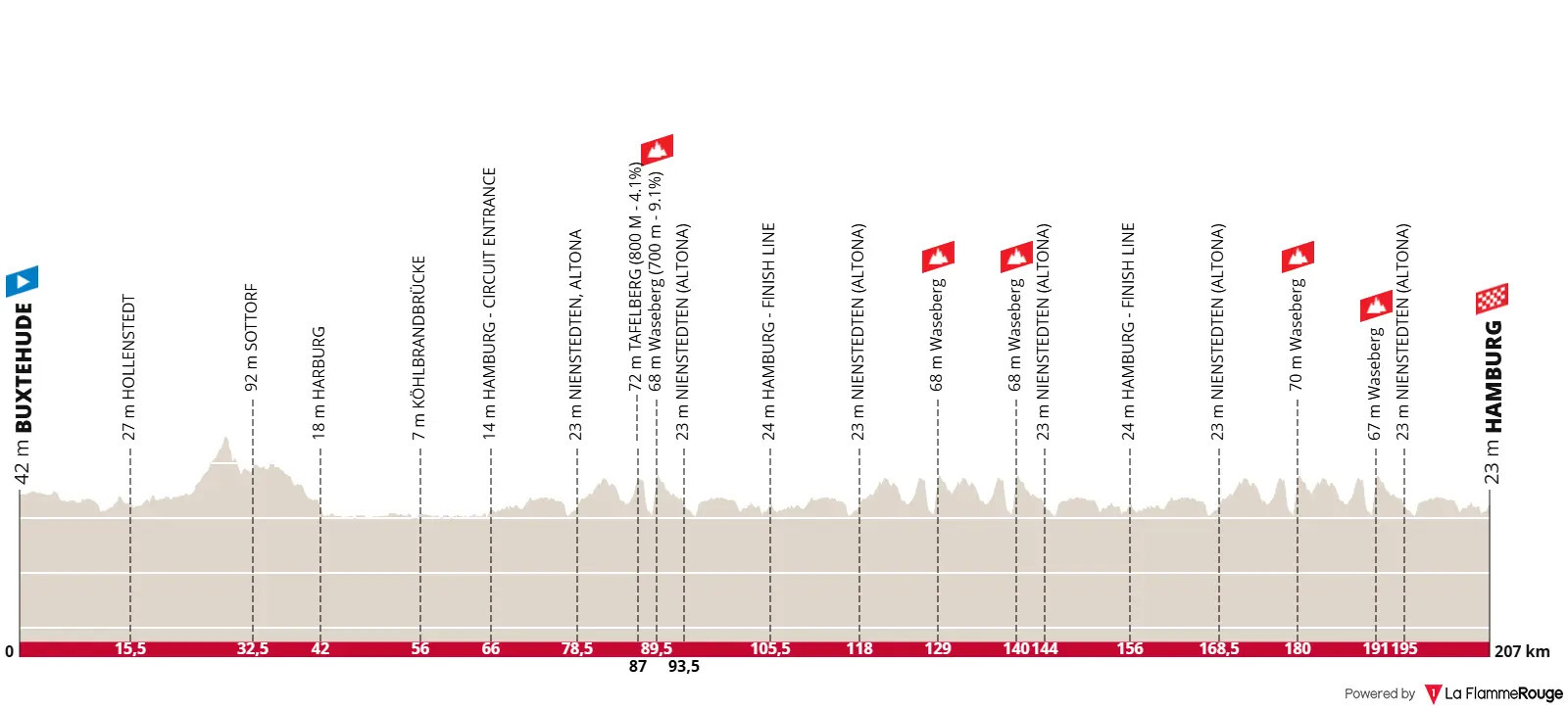
ADAC Cyclassics Hamburg 2026 – profiel
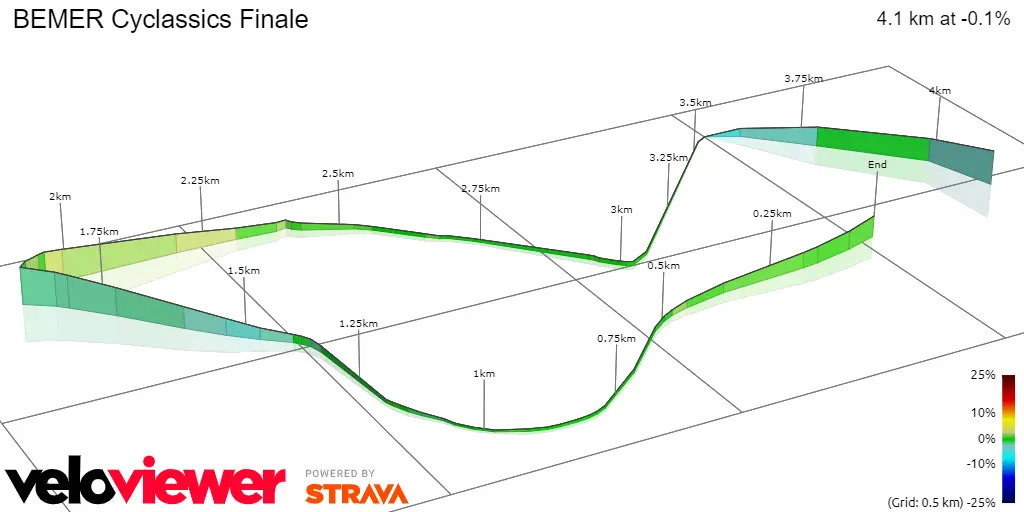
ADAC Cyclassics Hamburg 2026 – route
ADAC Cyclassics Hamburg 2026: favourites
The prediction of the 💻, Expected Win (xW):
|
Name
|
Team
|
Win %
|
|---|
Follow CyclingOracle on Instagram for more data, interviews and predictions.