Tour de France 2026 - general classification prediction
Saturday 27 June 2026 • Previews

Tour de France 2026 – Saturday 4 July to Sunday 26 July: Barcelona – Paris Champs-Élysées (3,333 km, ±56,300 hm)
The 113th edition of the Tour de France runs from 4 to 26 July 2026 from Barcelona to Paris. The peloton rides 21 stages over 3,333 kilometres with approximately 56,300 metres of climbing. It is the 27th foreign Grande Partenza and the third time Spain plays host; Barcelona is the first Spanish city to host the opening team time trial. After three stages in Spain, the race returns to France, where seven regions and 29 departments are visited before the stage caravan concludes on the Champs-Élysées in Paris.
The route is mountain-heavy and offers little compensation through time trials. There are only 45.7 kilometres against the clock spread over two stages: the opening team time trial of 19.6 kilometres in Barcelona and an individual time trial of 26.1 kilometres on day 18 between Évian-les-Bains and Thonon-les-Bains. Climbing specialists therefore have a structural advantage: relatively many mountain finishes and few time trial kilometres. Eight stages are classified as mountain stages, of which five have a summit finish.
Recent winners and records
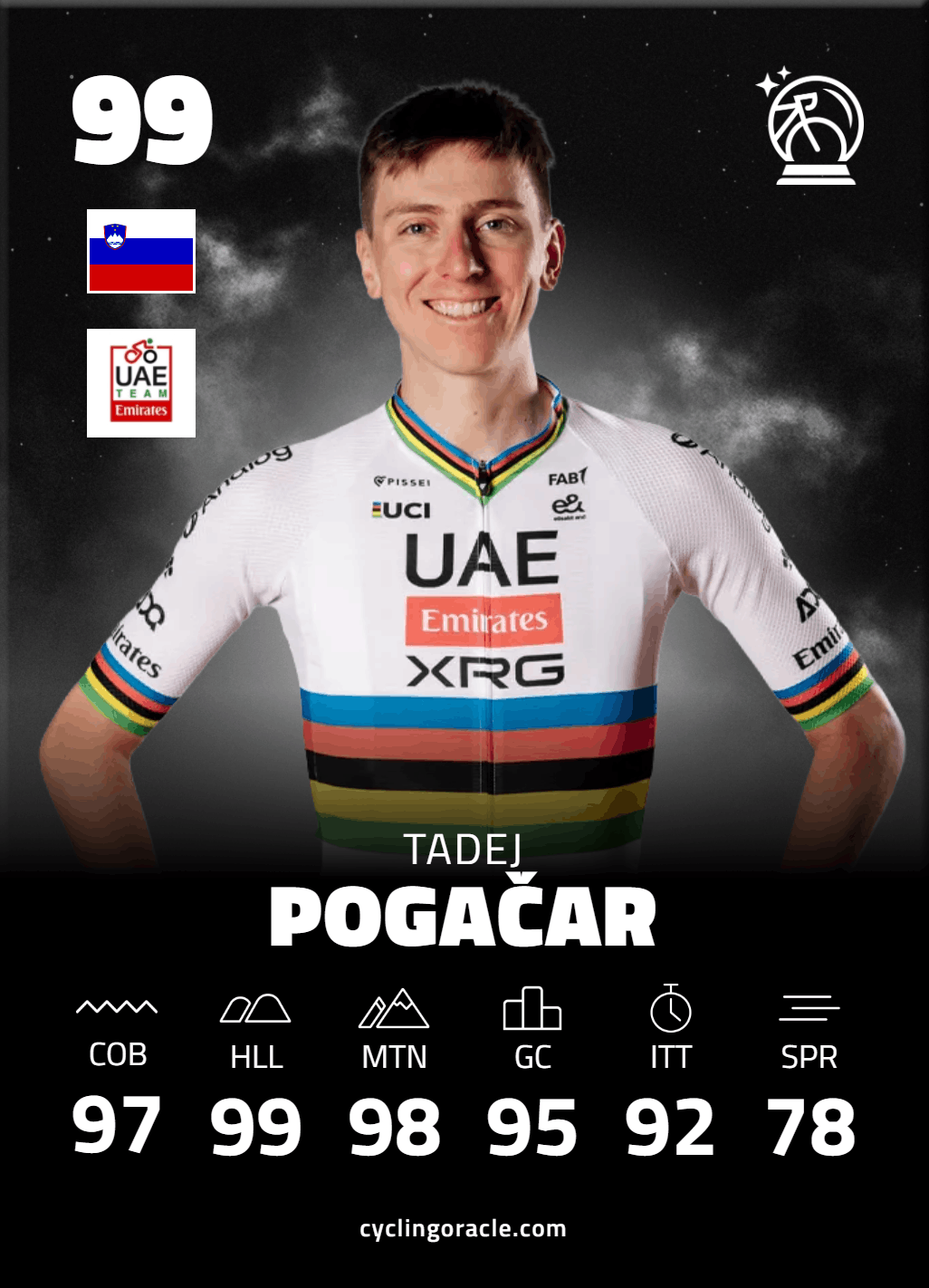
The Tour de France has been won exclusively by Tadej Pogačar and Jonas Vingegaard over the past five years. Pogačar triumphed in 2021, 2024 and 2025; Vingegaard in 2022 and 2023. Should Pogačar win again in 2026, he would stand at five overall victories, drawing level with Jacques Anquetil, Eddy Merckx, Bernard Hinault and Miguel Induráin as a multiple winner.
| Year | Winner | Team |
|---|---|---|
| 2021 | Tadej Pogačar | UAE Team Emirates |
| 2022 | Jonas Vingegaard | Team Visma | Lease a Bike |
| 2023 | Jonas Vingegaard | Team Visma | Lease a Bike |
| 2024 | Tadej Pogačar | UAE Team Emirates - XRG |
| 2025 | Tadej Pogačar | UAE Team Emirates - XRG |
 |  |  |
Candidates
Tadej Pogačar (UAE Team Emirates – XRG) and Jonas Vingegaard (Team Visma | Lease a Bike) have dominated the Tour de France over the past five years. Pogačar won three of the last five editions, Vingegaard two. Both riders reached the podium multiple times against each other and are again the two most obvious candidates for overall victory in 2026.
Remco Evenepoel (Red Bull – BORA – hansgrohe) combines time trial strength with growing climbing qualities and is considered a serious outsider. Isaac del Toro (UAE Team Emirates – XRG) confirmed himself in 2025 as one of the best young climbing specialists in the peloton. Florian Lipowitz finished third in the 2025 Tour; Mattias Skjelmose (Lidl – Trek) and Tobias Halland Johannessen (Uno-X Mobility) form a second tier of credible GC contenders.
Paul Seixas (Decathlon CMA CGM Team), born on 24 September 2006, is at 19 years old the youngest participant in the Tour de France in 89 years. The French climber is riding his first Grand Tour and is ranked in the top 10 of the UCI world ranking.
Week 1: Barcelona and the Pyrenees (4–12 July)
The Tour opens on 4 July with a team time trial of 19.6 kilometres through Barcelona, the first team time trial as Tour opener in 55 years. Stage 2 travels on 5 July from Tarragona back to Barcelona (168.5 km) over hilly terrain. Stage 3 from Granollers to Les Angles (195.9 km) enters the Pyrenees on 6 July; as a mountain stage with a finish in the Spanish ski resort of Les Angles, the first GC splits are possible here.
On 7 July the peloton rides from Carcassonne to Foix (181.9 km), a hilly stage in the Pyrenees. Stage 5 from Lannemezan to Pau (158.3 km) is the first flat stage, after which on 9 July the hardest stage of week 1 follows: from Pau to Gavarnie-Gèdre (186.2 km), one of the five mountain finishes of the Tour and the third hardest stage for the general classification. Gavarnie-Gèdre makes its debut on the Tour route. Stages 7 and 8 are flat transition stages via Bordeaux and Bergerac, followed by a hilly final stage from Malemort to Ussel (185.5 km) in the Massif Central on 12 July.
Week 2: Massif Central, Vosges and Jura (14–19 July)
After the first rest day in Cantal, week 2 starts on 14 July, the French national holiday, with stage 10 from Aurillac to Le Lioran (166.6 km) in the Massif Central. Stages 11 and 12 are flat transition stages via Nevers and Chalon-sur-Saône. Stage 13 from Dole to Belfort (205.8 km) is the longest stage of the Tour.
Stage 14 from Mulhouse to Le Markstein (155.3 km) on 18 July crosses the Vosges and is the fifth hardest stage of the general classification. The week closes with stage 15 from Champagnole to the Plateau de Solaison (183.9 km), the hardest stage of the entire Tour. The Plateau de Solaison makes its Tour debut and finishes in the Jura at high altitude; this is one of the decisive moments for the general classification heading into the Alpine phase. A second rest day in Haute-Savoie follows immediately after.
Week 3: The Alps (21–26 July)
Week 3 opens on 21 July with the individual time trial from Évian-les-Bains to Thonon-les-Bains (26.1 km). The limited time trial distance restricts the possible time gaps. Stage 17 from Chambéry to Voiron (174.7 km) on 22 July offers opportunities for breakaway riders.
Stage 18 from Voiron to Orcières-Merlette (185.2 km) on 23 July is a mountain finish at the ski resort of the same name. Stage 19 from Gap to Alpe d'Huez (127.9 km) on 24 July is the first of two consecutive finishes on Alpe d'Huez. Stage 20 from Le Bourg d'Oisans to Alpe d'Huez (170.9 km) on 25 July approaches the summit via the Col de Sarenne over the south-eastern flank, a new route profile. With a climber's score of 416, this is the second hardest stage of the Tour. The highest point of the race is the Col du Galibier at 2,642 metres. The Tour concludes on 26 July with the traditional stage from Thoiry to the Champs-Élysées in Paris (133 km).
With eight mountain stages, five summit finishes and only 45.7 kilometres against the clock, this route has relatively many mountain finishes and few time trial kilometres. The spread across the Pyrenees, the Massif Central, the Vosges, the Jura and the Alps provides multiple selection points. The double finish on Alpe d'Huez in the final week is unusual and could be decisive for the overall classification.
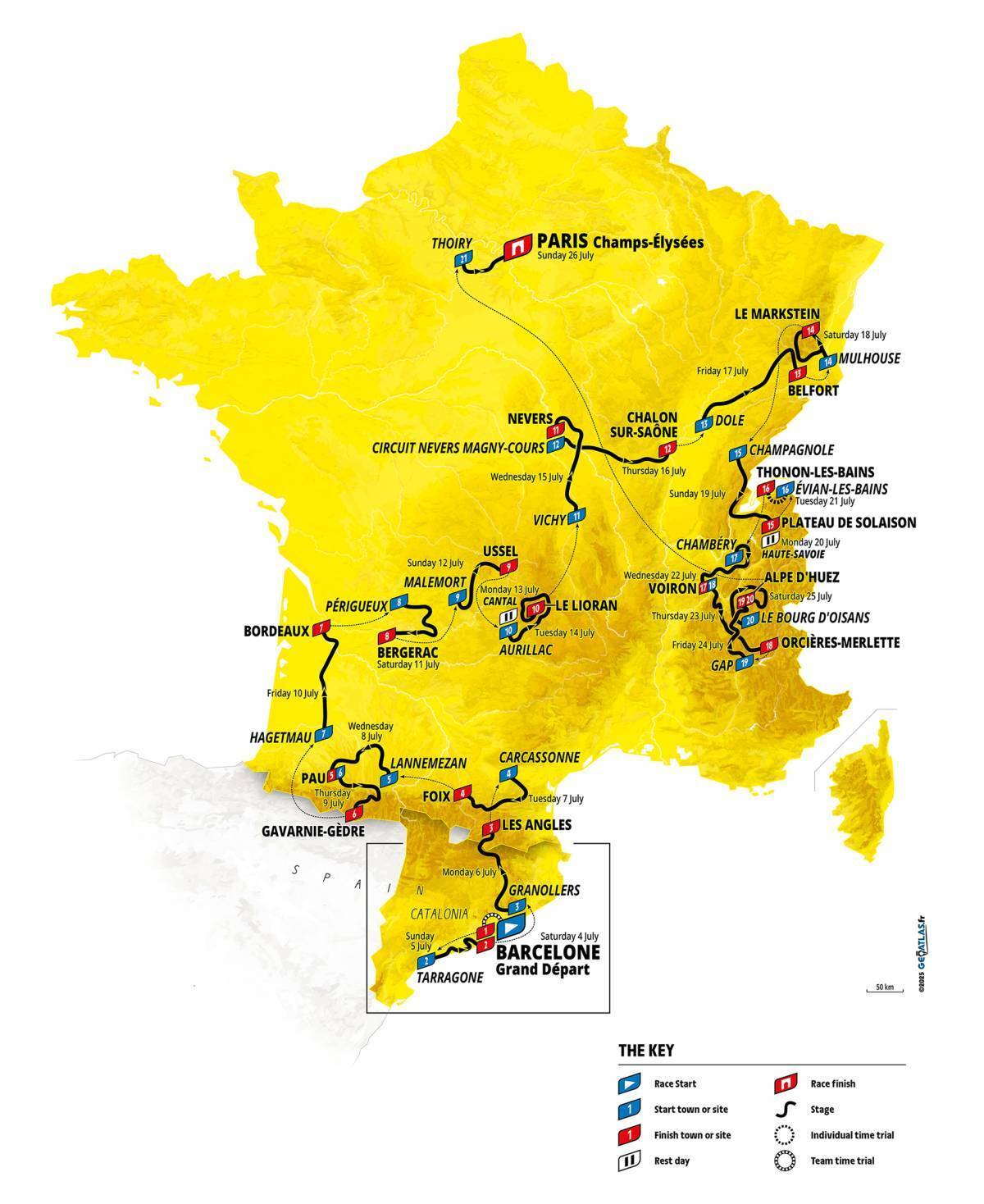
Tour de France 2026 – routekaart
Tour de France 2026: favorieten GC
De voorspelling van de 💻, Expected Win (xW):
|
Name
|
Team
|
Win %
|
|---|
🦄 Harold Tejada
*The unicorn is our joker, nice old-fashioned based on feeling
Follow CyclingOracle via Instagram for more data, interviews and predictions.