
Tuesday 7 July – Tour de France stage 4: Carcassonne → Foix (181.9 km)
Route
Stage 4 heads out from Carcassonne into the Pyrenean foothills. Over 181.9 kilometres with four categorised climbs, the stage finishes in Foix after a descent of 35.5 kilometres.
After a flat opening, the route rises at km 31 via the uncategorised Col de Villerouge (8.6 km at 3%). Shortly after comes the Col de Bedos (km 48.2 – 3.4 km at 4.4%, cat. 4, 485 m), followed by the Col du Paradis (km 64.9 – 5.9 km at 4.1%, cat. 3, 622 m). The two climbs are 16 kilometres apart and most likely determine the composition of the early breakaway.
Beyond the intermediate sprint in Quillan (km 93.4), the Col de Coudons begins (km 104.9 – 10.8 km at 5.5%, cat. 2, 883 m), the longest climb of the day. After the summit, the route crosses a plateau of around 20 kilometres through the Ariège massif. The Col de Montségur then follows (km 146.7 – 6.9 km at 6.6%, cat. 2, 1059 m). From the summit, 35.5 kilometres remain, mostly downhill to Foix. The final kilometre is virtually flat (0.8% average).
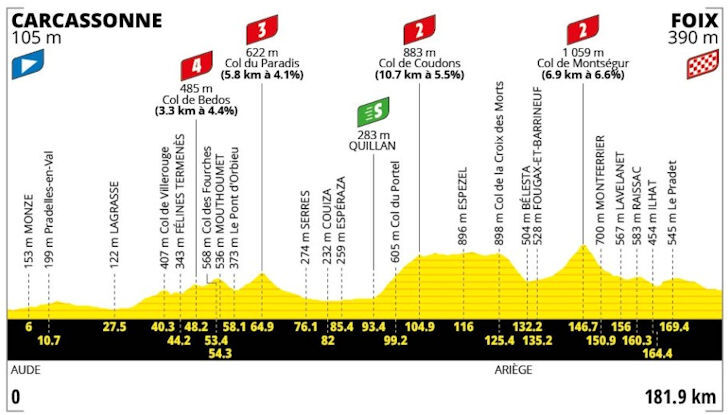
Tour de France 2026 etappe 4 – hoogteprofiel
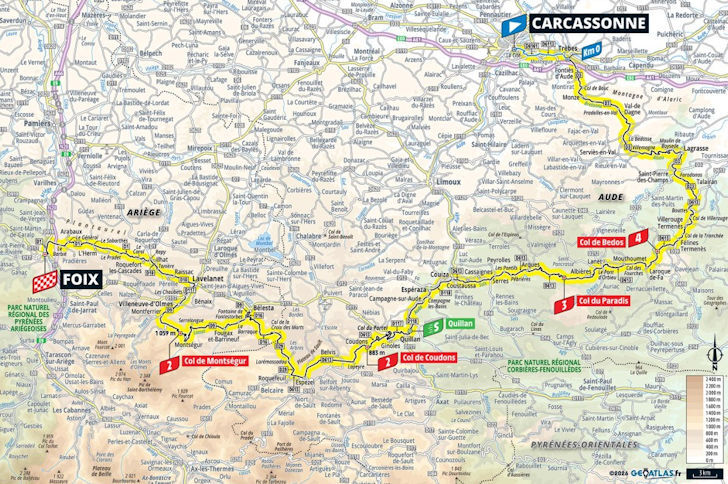
Tour de France 2026 etappe 4 – routekaart
Final kilometres
From the summit of the Col de Montségur (km 146.7), 35.5 kilometres remain. The route descends via Lavelanet and the Ariège valley towards Foix. The road rises slightly at certain points, but the overall trend is downward. The final kilometre is virtually flat (0.8%) and finishes in the centre of Foix.
Recent editions
Foix has a classic tradition as a breakaway finish in the Tour de France. The three most recent arrivals in the town all went to breakaway riders.
2022 – Hugo Houle (Israel-Premier Tech), solo of 40 km
2017 – Warren Barguil (Team Sunweb)
2012 – Luis León Sánchez (Rabobank)
Scenarios
The breakaway has a strong chance. GC teams have little reason to chase: the finish in Foix lies 35.5 kilometres after the final climb on virtually flat terrain, and classification riders risk no time gaps here. Puncheurs and attackers who survive the Col de Coudons and the Col de Montségur have the best profile for the finale.
Local
Foix is the prefecture town of the Ariège department, situated at the confluence of the Ariège and Arget rivers. The Castle of Foix, visible from the finish zone, dates back to the 10th century and was the administrative centre of the medieval County of Foix. The Col de Montségur, which the riders climb 35 kilometres before the finish, takes its name from the nearby Cathar castle, one of the most famous sites from the 13th-century Cathar history of the region.
Tour de France 2026 stage 4: favourites
The prediction of the 💻, Expected Win (xW):
|
Name
|
Team
|
Win %
|
|---|