
Sunday 5 July – Tour de France stage 2: Tarragona → Barcelona (168.5 km)
Route
Stage 2 of the 2026 Tour de France runs from Tarragona to Barcelona over 168.5 kilometres and 2,500 metres of elevation gain. The stage is flat until halfway, after which the route heads towards Begues and the finish on the Montjuïc circuit in Barcelona decides the outcome.
After 85 flat kilometres along the Costa Dorada, the route turns inland. The road climbs via the Côte de Begues (6.1 km at 6.5%), the highest point outside the finale. After the summit, the road descends for around 10 kilometres, followed by a short uphill stretch of 4.7 km at 3.4%, before the descent towards the Llobregat valley and Barcelona.
From around 30 kilometres from the finish, the peloton enters the Montjuïc finishing circuit. The circuit is 12.2 kilometres long and is covered twice. Each lap contains a descent, a false flat section and two climbs: the Côte du Château de Montjuïc (1.6 km at 9.3%, max. 13%) and the Côte du Stade Olympique (0.7 km at 7%). The finish is at the top of that second climb. At the first passage of the Côte du Stade Olympique, 24.4 kilometres remain and the peloton has to climb both climbs twice.
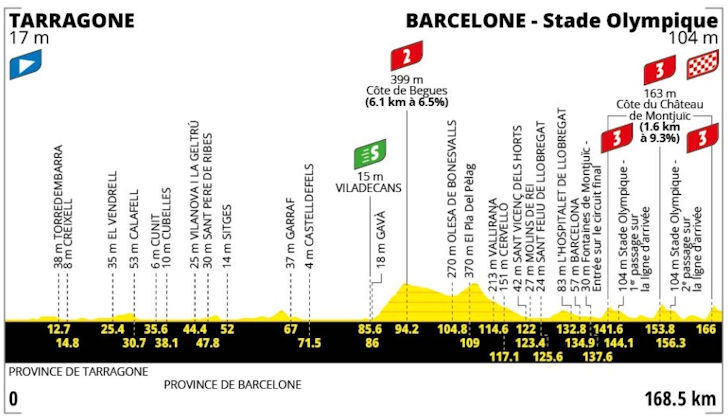
Tour de France 2026 etappe 2 – hoogteprofiel
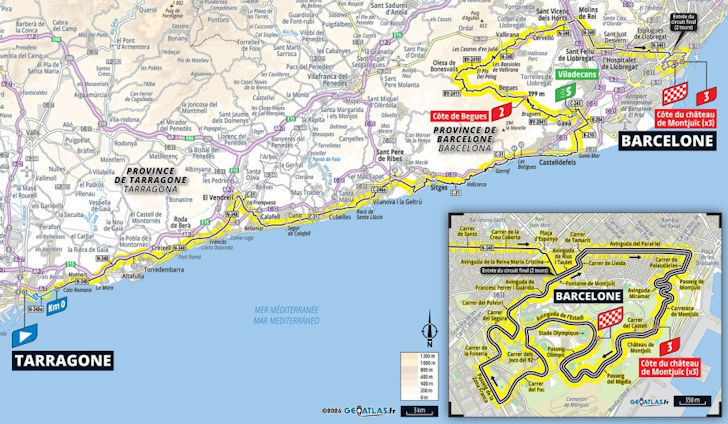
Tour de France 2026 etappe 2 – routekaart
Final kilometres
The finale consists of two laps of 12.2 kilometres on the Montjuïc circuit. Each lap starts with a descent and a short false flat section, then the Côte du Château de Montjuïc (1.6 km at 9.3%, max. 13%), a short one-kilometre descent and then the Côte du Stade Olympique (0.7 km at 7%). The finish is at the top of that final climb. The riders approach the finishing climb from a short descent after the summit of the Château climb.
Recent editions
The Tour de France previously finished in Barcelona (1957 and 1965), but has never raced a stage on Montjuïc. The Volta a Catalunya finishes annually on a circuit around this hill and provides the best comparison. The recent winners of that Volta finale in Barcelona:
2026 – Brady Gilmore (NSN Cycling Team)
2025 – Primoz Roglic (Red Bull - BORA - hansgrohe)
2024 – Tadej Pogacar (UAE Team Emirates)
2023 – Remco Evenepoel (Soudal Quick-Step)
2022 – Andrea Bagioli (Quick-Step Alpha Vinyl)
2021 - Thomas De Gendt (Lotto Soudal)
2019 - Davide Formolo (BORA - hansgrohe)
The Tour circuit differs from the Volta. The Côte du Château de Montjuïc has an average gradient of 9.3% over 1.6 kilometres in the Tour, with peaks of up to 13%. In the Volta a Catalunya, a different section of the castle climb is used, with lower averages. Moreover, the Tour finishes on an additional climb, the Côte du Stade Olympique, making the overall circuit more demanding than the Volta finale in Barcelona.
Scenarios
The Montjuïc circuit is prime territory for puncheurs. The Côte du Château de Montjuïc (1.6 km at 9.3%) demands explosiveness. Those who crest this climb at their limit must also handle the 700-metre finishing climb at 7%. Riders lacking explosive power will lose time here.
GC contenders who lost little time in the team time trial of stage 1 are close to the yellow jersey. Stage 2 is the first opportunity to create GC gaps. A GC rider with puncheur qualities can claim or strengthen the yellow jersey here. Puncheurs who master the Château climb at their limit retain chances on the short finishing climb.
Local
Tarragona was the Roman capital of Hispania Citerior and is on the UNESCO World Heritage List. The stage starts on the Rambla Nova, the city’s main boulevard along the coast.
Barcelona is the capital of Catalonia. Montjuïc played a central role in the 1992 Olympic Games: the road cycling events were also held on and around the hill. The Tour de France brings its Grand Départ to the city for the first time in 2026.
Tour de France 2026 stage 2: favourites
Computer prediction 💻, Expected Win (xW):
|
Name
|
Team
|
Win %
|
|---|
🦄 Mathias Vacek
*The unicorn is our joker, nice old-fashioned based on feeling